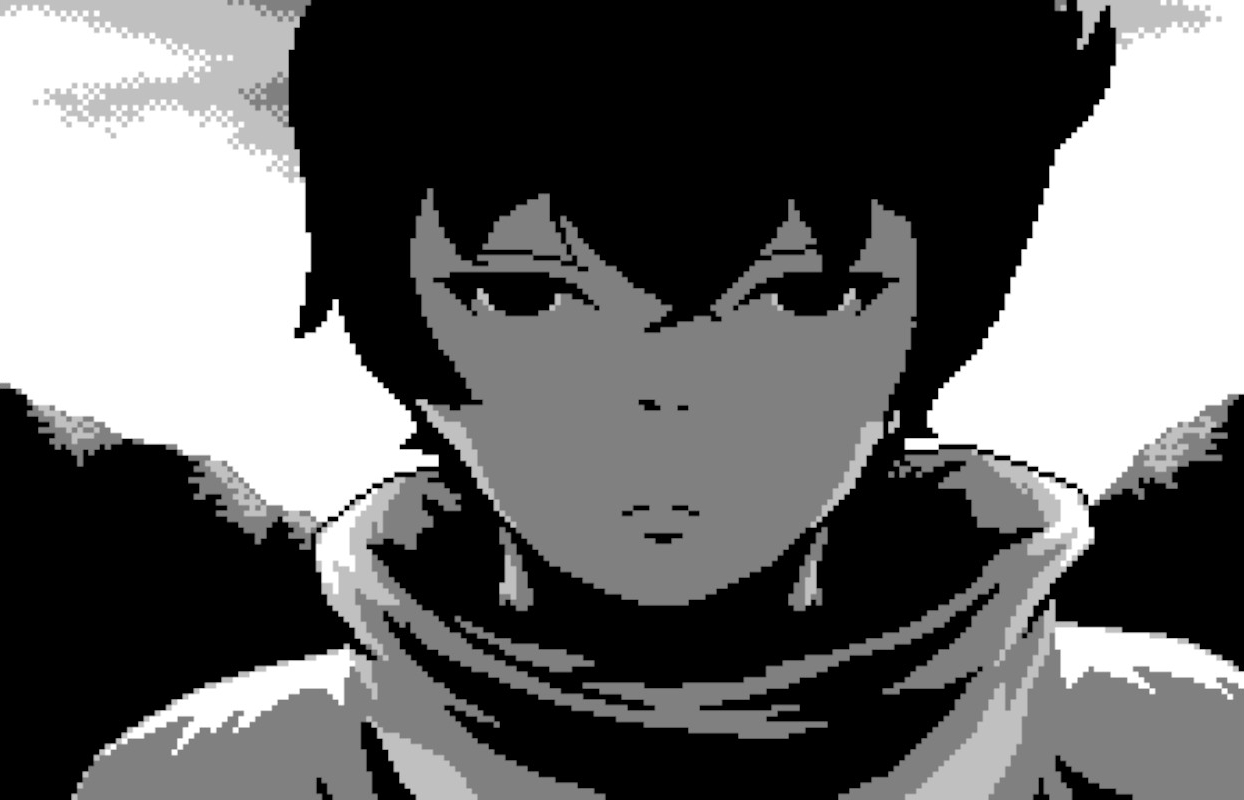
The Stairs Only Go Down
i'm always thinking about Void Stranger
i've wanted to write about this game for ages, for a million different reasons. shit, i want to write a book. i want to mimic Tim Rogers and make a 4 hour video breaking apart every little 16px square of this game. but i'm terrible at committing to things, so today i'll just poke at something small...
this is intended for people who have played Void Stranger already and reached an ending, and want to hear about game design. imo, you should play this game knowing as little as possible. if you aren't interested in playing it, read this article until you become interested, and then close this tab and go play it instead. i'm not getting paid for this anyway
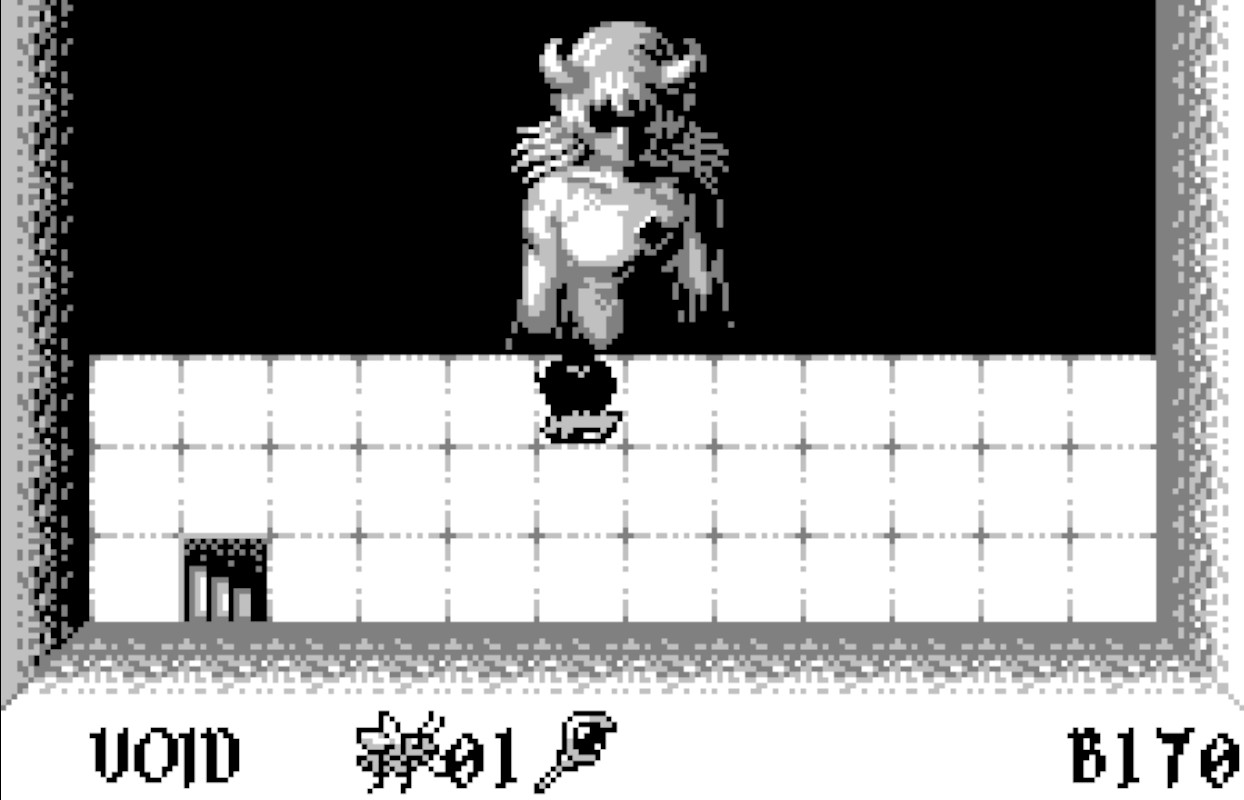
You enter the room fearlessly
Void Stranger is a puzzle game, and a difficult one. It has lots of moments where you stare desperately at the shape of a level, trying to work out in your head how you can turn the knobs and dials to solve the problem in front of you. You will get stuck a lot, you will fall down a lot of pits or get cornered by monsters, and then you'll finally go, "ah, shit", and the answer will hit you like a hammer. You'll slap your face, assemble the solution, and go down the stairs to the next puzzle.
Void Stranger is also a weird game from the very first minute. The start game screen has a weird password-like "brand" screen. The dungeon is backed with unnerving and grinding music. There are unreadable murals. There's foreboding statues, big and small, that don't serve any obvious purpose but to put you on edge. Some rooms already seem to have the puzzle solved for you. You sometimes bump into other creatures, from humans to demons to... oddities, and they often get very cryptic and sad. It's obvious that you are deep in a place full of history and probably a whole lot of secrets. You gain a growing feeling that you really should try to make sense of your surroundings, that there must be a grand understanding hiding amongst the halls.
"Am I missing something?"
Digging deeper and deeper, you become familiar with some puzzle-solving tricks, but the grand mystery is still unscratched. And inevitably, after descending 100 or more floors, you hit a mental wall. You reach the puzzle that's way too hard for you, seriously. It's definitely impossible. And you start to curse yourself, because you know that you missed some important Thing that would make the puzzle trivial. You don't know what that Thing is, but you don't have it. You curse your friends for recommending the game, knowing they'll tease you for missing the Thing when they found it so easily. You curse the developers, because they built a game that let you miss the Thing.
The stairs that lead you here are gone. You have four directions of movement and a weird staff. You don't have the Thing. You can't go back and get the Thing. There is no Thing. There's no "back" at all. It's not that kind of game, yet.
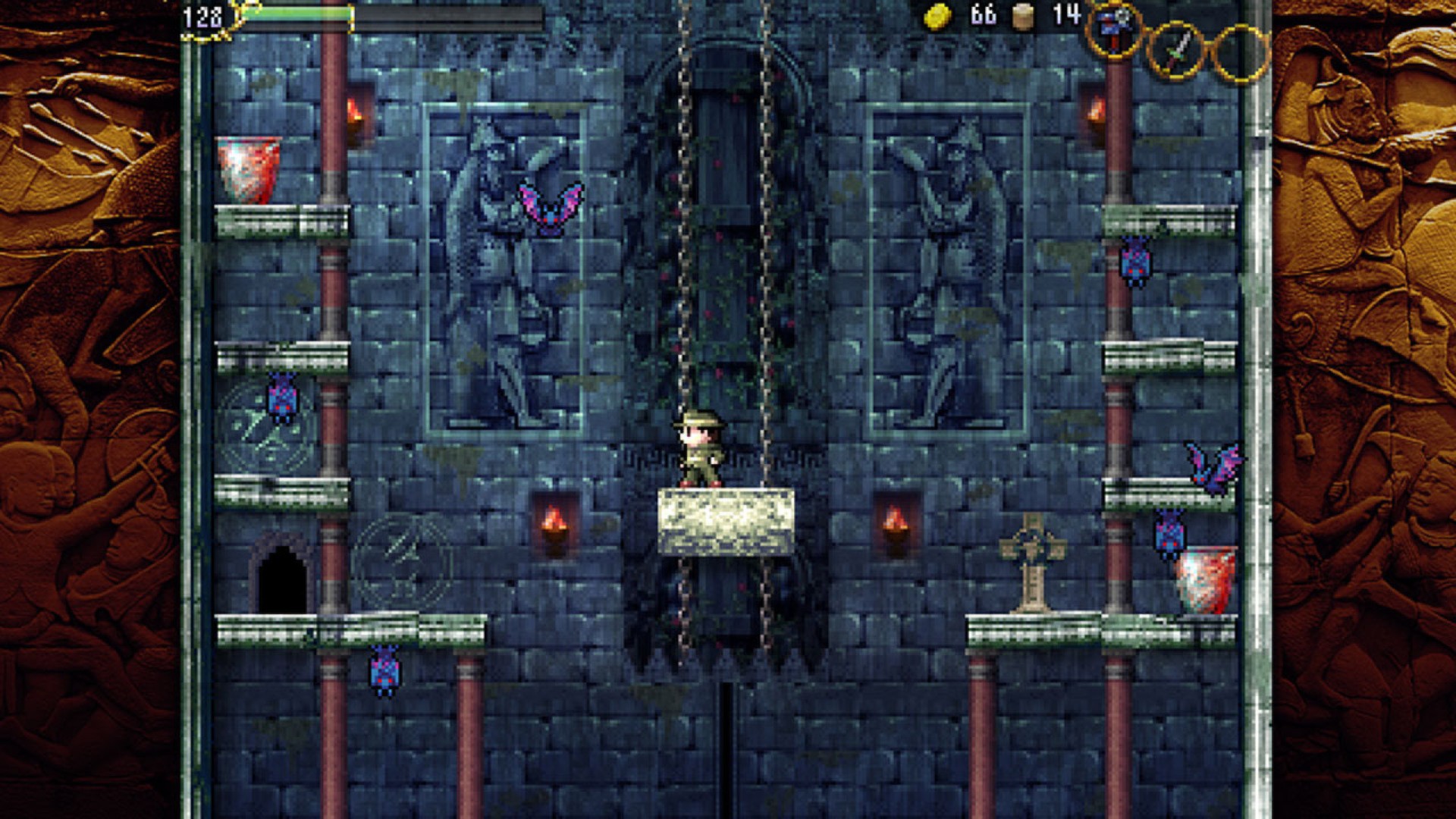
Am I Missing Something?
Think Tunic, think Silksong, think La-Mulana. If you've played an exploratory game before, with a big world, with lots of stuff to find, with new powerups - an open world, a search-action, a metroidvania, a metroidbrainia, an adventure game, whatever - you know this feeling. You see a ledge that you can't reach. You think, maybe you'll find the ability to double jump soon. Or a grappling hook. Or maybe there's a bounce pad nearby. Or maybe the previous room has a hidden door. Or actually, maybe you're somehow fumbling the basic movement and everyone else can get to that ledge no problem. Maybe you're not supposed to get up there yet, but you think you can cheese it. Should you even bother now? How much time should you spend trying to get up that ledge?
This situation crops up all the time while exploring, so much that it's expected. It's part of the fun. Seeing a ledge you can't reach is a tension. It's a mystery. It's a hint at a grander scope beyond what you know. The world becomes bigger. The promise of that ledge is enough to get your mind gnashing at possibilities. The beautiful thing about video games is that you don't know how many pages are left.
Unfortunately, the problem arises when you can't judge how important that ledge is. Exploration games are often vague with directions, and encourage players to create a path for themselves. There usually is a "core path", that is, a path that progresses the story, that unlocks new abilities or information. But you don't know how important the ledge is, because the game does not tell you which path is the core path. And so, you spend 15 minutes fucking around and trying to find your way up there.
And if in your fucking around, you think to yourself, "Am I missing something?" you might be compelled to travel backwards, in an attempt to find the Thing that will allow you up the ledge. You start to sweat. Did I miss it? Should I go back? Was the thing up some other ledge? It's a mystery for sure, but it's also frustrating and maybe even a little boring.
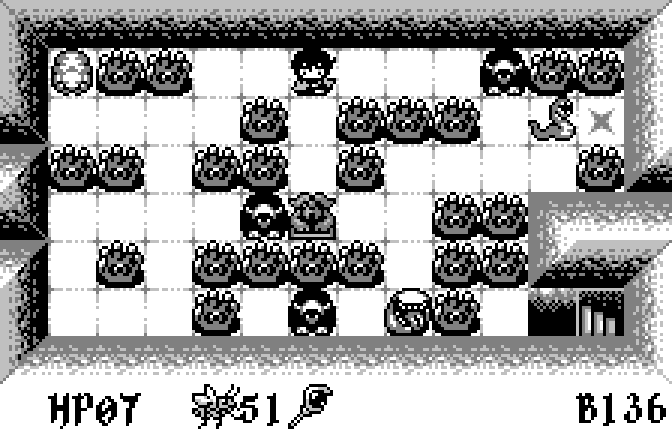
The Stairs Only Go Down
Void Stranger is a game about exploration and discovery. It is also very linear. Once you solve a puzzle and go down the staircase, you are committed. There is no going back to find what you missed. The deed is done. So when you get stumped by the most obnoxious puzzle, you are forced to admit, "I must be able to solve this somehow". Maybe you need a hint, maybe you need to take a break and try tomorrow, but the one thing you never need to do is backtrack, because you are not allowed to backtrack. The stairs only go down.
This isn't some revolutionary idea! Like, you can't backtrack in the original Super Mario, or in a visual novel, or in a shmup. You couldn't backtrack in ZeroRanger. If you missed a secret, you missed a secret, but the game is still valid and still beatable. If you want to find that secret so bad, you'll remember it on your next run.
But Mario and ZeroRanger are action games are about going forward. In games about exploring, you have to be able to go backwards, right? Freedom to choose your own path is absolutely vital to that sensation of "exploration" and "discovery"... right? What is Hollow Knight if you aren't allowed to wander off in a dozen different directions? Yet that frustration of "am I missing something?" is so, so, so common in metroidvanias. A little frustration's not always a bad thing! But it definitely is a thing.
In many ways, starting a game of Void Stranger is closer to starting a roguelike or a shmup. It operates in "runs" where you retread a path many times. The world is dripping with things to miss, but you'll have to find them next run. And so you go down, and not up.
It's a simple design decision, but it's such a good one. The puzzles are cruel and frustrating, and so System Erasure does you a kindness by telling you not to waste your time worrying about the past. Focus on the puzzle in front of you. It might be hard, but it's not impossible.
The World Rewritten
Of course, by forcing you to move forward, Void Stranger also forces you to sit with all its oddities, its statues and blinking eyes and grand mysteries, letting them boil and soften in your skull, an unsettling but compelling tension building up as you solve puzzle after puzzle. You are so desperate to figure out what the hell is going on. You don't even know how much dungeon is left, or what the "shape" the game has. Mysteries from the first few floors will begin to unravel only once they're far behind you.
Eventually, you reach an ending. Likely, it's the "bad" one. You realize you've found the end of the path. You failed, but the bad ending is so god damn gorgeous, it's totally worth it. And finally, finally, finally, the game shows you how to go up. It tells you, "do it again."
Giving you the ability to go backwards only after "beating the game" is perfect. You now know the core path, and you have proven you can travel it. You know where the bottom is, so you can focus on improving. You can make fewer mistakes. And you're armed with just a little bit of the lovely knowledge you've been dying for. The world suddenly feels bigger, the path less linear, but only after you've seen it all the way through once. ZeroRanger was about learning through reptition and observation, and so is Void Stranger.
Of course, there's more going on the second time through. The statues might make a little more sense to you now. Maybe you're subconsciously piecing together the role of the strange murals you see. Maybe you've begun to see some patterns in the seemingly endless floors. You've finally learned how to go back up, and now you have a reason to.
Void Stranger is a game that makes you feel like you're lost, deep, and stuck, that you're basically bumbling your way through the labyrinth. It's very obvious that you're missing all sorts of secrets every time you go down to the next floor. But, by simply making the stairs one-way, the game says, "It's okay. Don't worry about those things yet. Just keep going forward." When you finally find those secrets, Void Stranger blossoms open into a massive, sprawling world, but until then, it's happy to be a straight line. This blossoming game structure is so fascinating to me, and it's such a clever approach to the act of exploration, I can't help but adore it.
I'd love to see other games play around with their shape the way Void Stranger did. It's the only game that has drowned me so beautifully in "anything is possible".
thanks for reading! i'll write about Void Stranger again. my friend taught me the phrase "tsundere-likes" recently and i've been a bit obsessed with the concept since, so...
Lily 💜